Wednesday, June 11, 2008

Contour Map


Because Contour maps are a type of hypsometric map it makes sense to use similar maps from my last entry to show the similarities and differences between the two. This contour map is similar to a hypsometric map because it is showing information on a third dimension, the time it takes to travel by rail in England. This map uses both colors and contour lines to represent the third dimension. The author of this website calls these contour lines isochrones. The lines represent one hour of time. 

Hypsometric Map

My Society  has a great website for looking at Hypsometric and Contour maps. For the entry in my map catalog I will focus on the Hypsometric properties of this map. The third dimension that is being communicated is the time it takes to get from Cambridge to outlying cities in England. Red is fastest with blue being the slowest. A pattern emerges with it taking less time to reach destinations within a tight circle and then taking longer as the distance from the center increases. A few exceptions seem to follow specific routes in an almost straight line radiating out from the center. These are probably major rail ways. 

Planimetric Map


This is a Planimetric map of my hometown, Pensacola Fl. The defining feature of a planimetric map is the lack of any representation of relief. Planimetric maps are usually street maps because knowing elevations aren't as important for getting around. This map was found at FloridaBrasil.com

Monday, June 2, 2008

Cartogram

University of Michigan
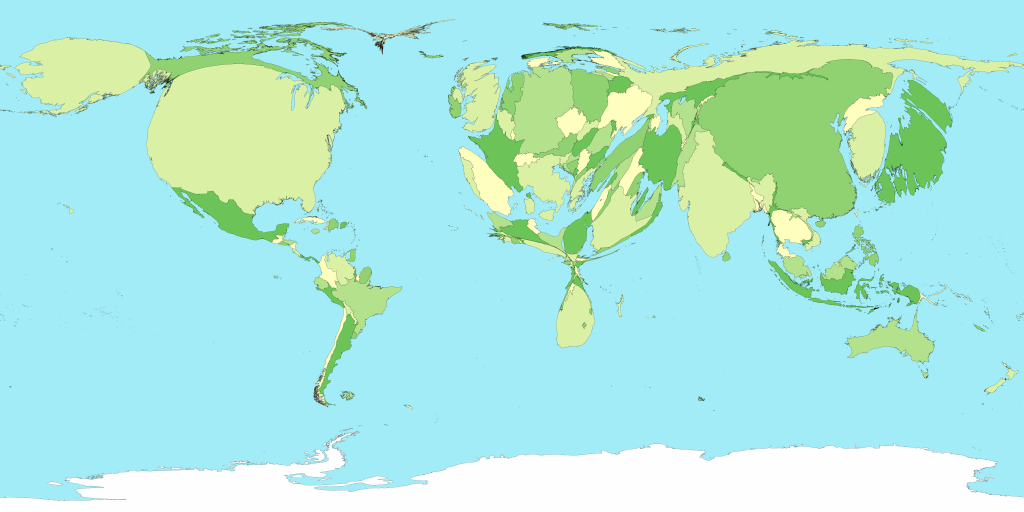
Cartograms are a sort of statistical thematic map. A geographer takes statistical data and then distorts the area of a map to represent the magnitude of the variable. For example, this map is a cartogram displaying information on green-house emissions. The larger the area the more green-emissions. It's easy to identify which regions are doing their part for the environment and which ones are not. 

Statistical Map

Britannica Online
This map is a classic example of a statistical map. As the map explains, each dot represents 10,000 acres of corn. It allows the reader to quickly and easily see a dense concentration around the midwest states. 

PLSS Map

National Atlas
The PLSS system is a systematic Cadastral map. Most of the United States uses this system to divide up land. Principle meridians perpendicular to base lines are the basis for this system. Every 6 miles in all 4 directions another line is drawn. Zones created by north-south lines are called townships and zones created by east-west lines are called ranges. This system is most common in the midwest and western part of the country that was not influenced by the colonial metes and bounds system. 

Cadastral Map

Website of Delaware County Auditor 
This is a cadastral map of Delaware County. Notice the ordered, systematic parceling out of land. This is also a very good example of  PLSS (public land survey system) Map. In PLSS maps the area is divided down to the tiny parcels of land that indicate ownership.